Vegetables · Kale
How to pick good Kale
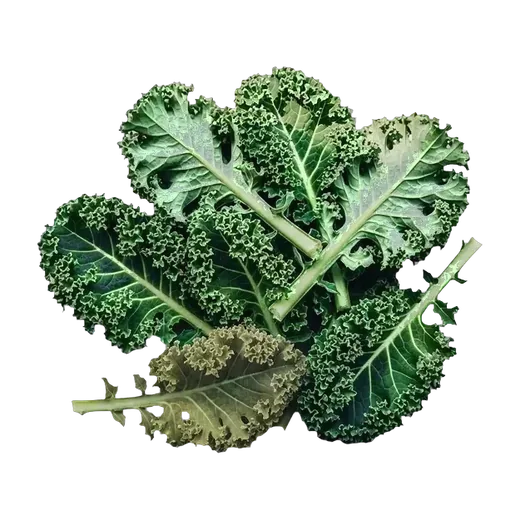
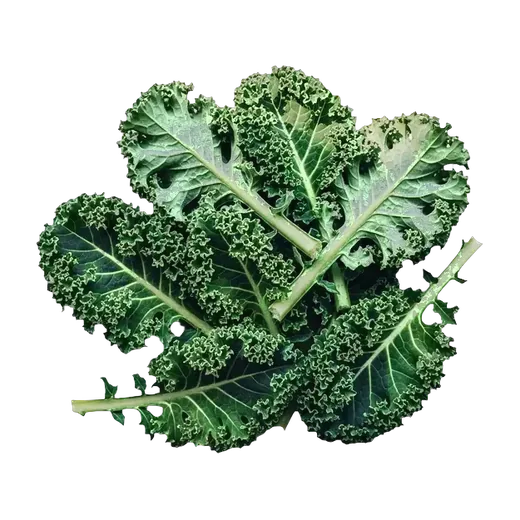
Deep, lively color right to the leaf edge — crisp leaves that hold their shape
How to pick
Color is your fastest cue, but read it as depth and evenness rather than one particular shade — blue-green on curly and lacinato types, green with purple stems on Red Russian. What you want is a leaf uniformly rich in its own color, with no yellowing anywhere. Lift a leaf and notice whether it holds its shape with a slight stiffness (fresh kale has a satisfying firmness), or droops immediately (past peak). Check the midribs: fresh stems are firm and light green to cream-white — purple on Red Russian — while soft or discolored midribs indicate the bunch is declining. For bagged or pre-cut kale, scan through the packaging for any yellow leaves or dark wet patches. At the stem base, fresh kale has a clean, mild grassy-vegetal smell; a sulfurous or musty odor means it is older than it looks.
Red flags
- Yellow tinge or yellow tips on outer leaves — early chlorophyll breakdown, the bunch is past its peak
- Sulfurous or musty smell at the stem base — past prime even if leaves still look acceptable
- Any dark brown or black lesion on a leaf surface — breakdown in bagged kale spreads quickly
- Midrib or thick stem that feels soft or spongy rather than firm
- Bagged kale with pooled water at the bottom — more than light condensation means active cellular breakdown
How to store
Refrigerate unwashed at 32–40 °F (0–4 °C) in a loosely sealed plastic bag with a dry paper towel to absorb moisture. Use within 5–7 days for whole bunches. Wash just before use — excess moisture accelerates yellowing and decay.
In the app
Scan
In the aisle, in seconds
Point the camera: pick or pass for that exact item, and the cue to trust next time.

Season where you live · Nutrients · Taste · Myths · Ayurveda


Free to install.
More to pick
Picking, storage, and freshness guidance is drawn from peer-reviewed postharvest research and agricultural extension sources. The sources are named in the app.