Vegetables · Bitter Gourd
How to pick a good Bitter Gourd
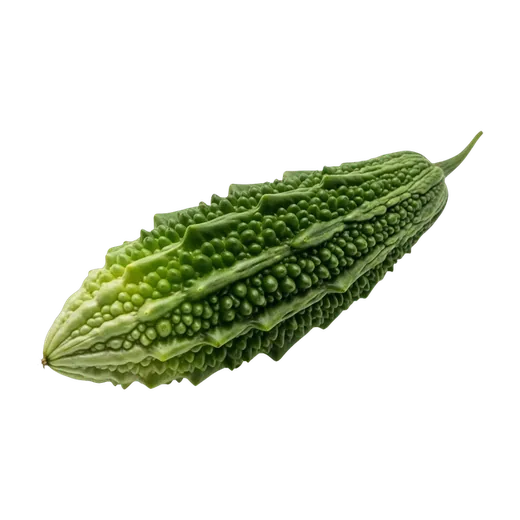
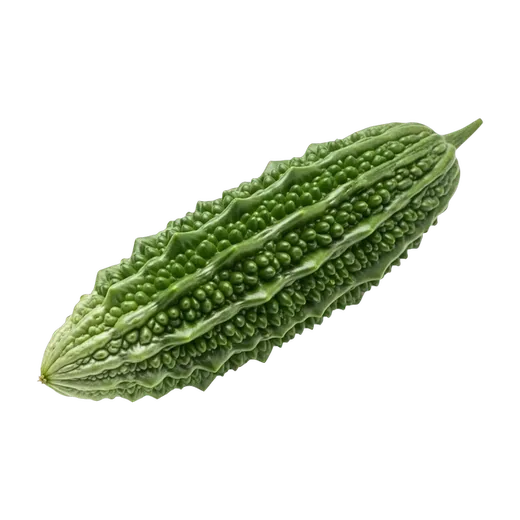
Uniformly green with a waxy sheen — that's bitter gourd at its crispest and most flavorful
How to pick
Start with color — the entire skin should be uniformly green with no hint of yellow anywhere. Any yellowing signals the onset of ripening: the flesh is softening and the flavor profile is shifting. Next check the sheen: fresh bitter gourd has a natural waxy shine across its warty surface. When that gloss fades and the skin looks flat and matte, the fruit is past its best even if still mostly green. Pick up the gourd and feel its weight — a good one is firm and dense for its size with no soft spots. The distinctive warts and ridges should feel plump and well-defined; flattened or soft tubercles signal moisture loss.
Red flags
- Any orange tinge appearing anywhere on the skin — orange signals full ripening beyond the yellow stage; the interior is already soft and gelatinous and the fruit is approaching splitting
- Dull, matte surface on a fruit that still appears uniformly green — sheen loss often precedes visible color change and is an equally reliable early-decline signal; color alone is not sufficient
- Stem end pale, brown, or desiccated rather than green and firm — a fresh stem end stays plump and green; browning at the stem signals extended time off the vine and internal quality decline
- Sour or off aroma when brought close to the skin — fresh bitter gourd has a mild faintly green-vegetal scent; any sour or fermented smell signals internal breakdown beyond what the surface shows
- Splits or cracks anywhere on the skin — the fruit is approaching full ripening and dehiscence; flesh quality is gone
How to store
Store bitter gourd in the crisper drawer of the refrigerator in a perforated plastic bag, or a standard plastic bag left slightly open, at 50–54 °F (10–12 °C) with 85–90% relative humidity. Note: most home refrigerators run colder than the ideal range — store in the warmest part of the crisper (toward the front) and use within 4–5 days to limit chilling injury risk. Temperatures below 50 °F (10 °C) — below the bottom of the ideal range — risk chilling injury: surface pitting, dark watery patches, and blackening. A cool pantry or countertop at 60–65 °F (15–18 °C) works better than a cold fridge for a 2–3 day window. Keep away from high-ethylene fruits such as apples, bananas, and ripe tomatoes — ethylene accelerates yellowing. Use before any yellow appears.
In the app
Scan
In the aisle, in seconds
Point the camera: pick or pass for that exact item, and the cue to trust next time.

Season where you live · Nutrients · Taste · Myths · Ayurveda


Free to install.
More to pick
Picking, storage, and freshness guidance is drawn from peer-reviewed postharvest research and agricultural extension sources. The sources are named in the app.