Vegetables · Butternut Squash
How to pick a good Butternut Squash
Pick the deepest matte tan — a dull, stripe-free skin means it ripened sweet on the vine
How to pick
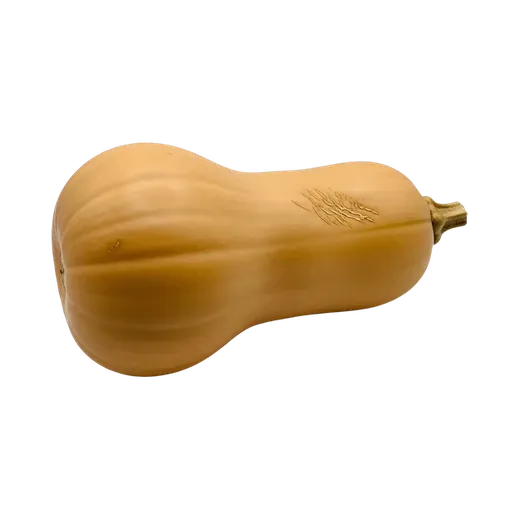
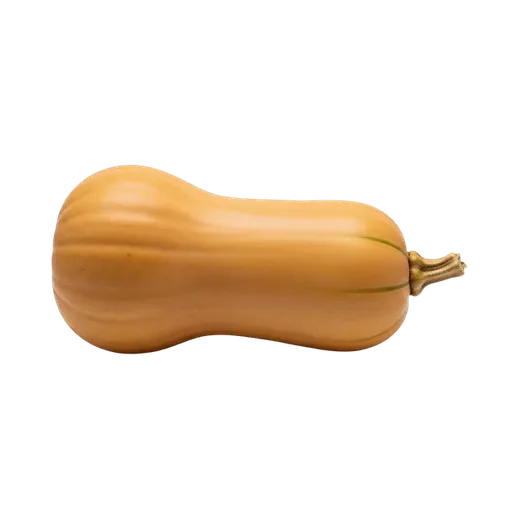
Look for deep, uniform matte tan skin with no glossy sheen — a dull finish means the squash ripened fully on the vine and the flesh is sweet. Any green longitudinal stripes should have faded to barely visible; prominent bright green streaks signal an immature, watery, less sweet squash. A long solid neck holds the most seedless flesh. If the stem is still attached, it should be short, hard, dry, and corky tan-brown — not soft or green. The squash should feel rock-hard and heavy for its size, with the rind giving nothing under a gentle press. The surface should be smooth and unbroken, with no soft sunken areas.
Red flags
- Soft or sunken areas that feel spongy under a gentle press — internal rot has started
- Sunken, moist, or spreading lesions, or pale mold fuzz, especially near the stem or blossom end — fungal decay concentrates there first (small, dry, flat corky scars on their own are just cosmetic russeting)
- Cuts, deep scratches, or punctures in the rind — entry points for rot
- A stem end that is dark, moist, or oozing — decay already underway
- Musty, fermented, or sour smell from the skin or stem end
How to store
Store whole in a cool, dark, well-ventilated spot at 50–55 °F (10–13 °C) — a pantry, cellar, or unheated room. Do NOT refrigerate: winter squash are chilling-sensitive and develop surface pitting and faster rot below about 50 °F (10 °C); a standard fridge (35–40 °F [2–4 °C]) shortens their life. Keep out of sealed plastic so air can circulate. Whole and uncut, expect 2–3 months at 50–55 °F (10–13 °C), and longer — up to several months — in a steady cool cellar. At normal room temperature (65–75 °F [18–24 °C]) it keeps a few weeks. Once cut, wrap the cut face tightly and refrigerate at 40 °F (4 °C), using within 5 days.
In the app
Scan
In the aisle, in seconds
Point the camera: pick or pass for that exact item, and the cue to trust next time.

Season where you live · Nutrients · Taste · Myths · Ayurveda


Free to install.
More to pick
Picking, storage, and freshness guidance is drawn from peer-reviewed postharvest research and agricultural extension sources. The sources are named in the app.