Vegetables · Iceberg Lettuce
How to pick a good Iceberg Lettuce
Heavy for its size, creamy white at the cut
How to pick
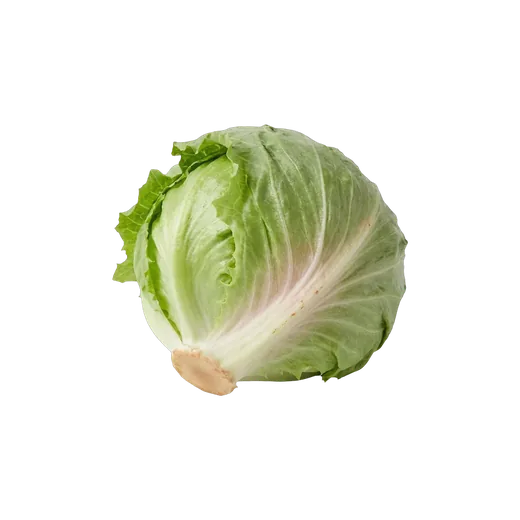
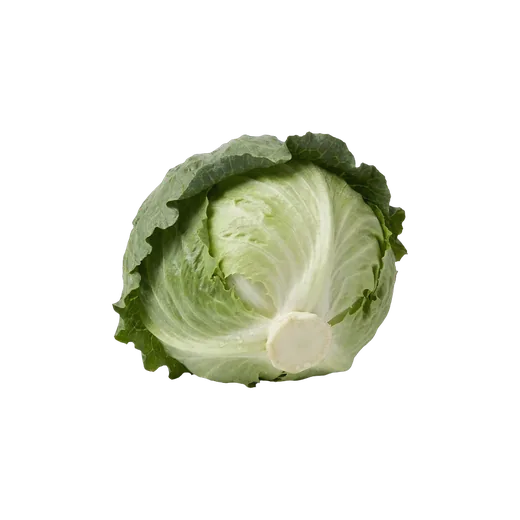
Pick up two heads of the same diameter and take the heavier one — weight is density, and density is leaf count plus water still in the leaves. Then cup the whole head in one open palm and press with moderate, even pressure. The right answer here is counterintuitive: a good head is firm but yields slightly and springs back. A rock-hard head is overmature, not better, and overmature iceberg turns bitter and tough. Never squeeze with your fingertips — concentrated pressure bruises the leaves, and bruising is exactly what starts the browning. Turn the head over and look at the cut base: creamy white or ivory means it was trimmed recently, tan or rust means it has been sitting. Judge the colour of the head itself, not the loose wrapper leaves around it — the wrappers are darker by design, and reading them instead of the head is the common mistake. The head shows through wherever they gap, and it should be bright light green with no yellow cast.
Red flags
- A head so hard it gives nothing at all under an open palm, its outer leaves stretched flat against it with no ruffle standing free — overmature, and overmature iceberg goes bitter and tough
- A pink flush running along the white midribs of the outer leaves — pink rib, seen in overmature heads and after warm storage
- Small dark-brown oval spots on the white midribs — russet spotting, caused by ethylene given off by fruit stored nearby
- A tan, rust or dark ring on the cut base — the head was trimmed a while ago
- Brown, dried-out necrosis along the leaf edges — tipburn, a defect from the field that does not improve
- A yellow cast on the head under the wrapper leaves — chlorophyll breaking down with age
How to store
Keep it in the coldest part of the fridge that will not actually freeze it — lettuce freezes at 31.6 °F (−0.2 °C), so keep the head off the back wall and away from the freezer vent. Put it in a loose or perforated plastic bag in the crisper: it wants very humid air, but a fully sealed bag sweats and the trapped water speeds decay. Store the head whole and uncut — cutting or breaking the midribs starts the browning within hours. Wash it after, not before; water left sitting in the head fosters decay. Expect 7–10 days at home. Commercial cold rooms get three weeks or more out of it, but a home crisper is warmer and, more to the point, is not ethylene-free. Lettuce is extremely sensitive to ethylene — as little as one part per million does damage — so keep it out of the drawer that holds apples, pears, peaches, cantaloupe or ripening tomatoes. That gas is what puts the russet spots on the midribs.
In the app
Scan
In the aisle, in seconds
Point the camera: pick or pass for that exact item, and the cue to trust next time.

Season where you live · Nutrients · Taste · Myths · Ayurveda


Free to install.
More to pick
Picking, storage, and freshness guidance is drawn from peer-reviewed postharvest research and agricultural extension sources. The sources are named in the app.