Vegetables · Romaine Lettuce
How to pick a good Romaine Lettuce
Pale ribs unmarked, outer leaves deep green
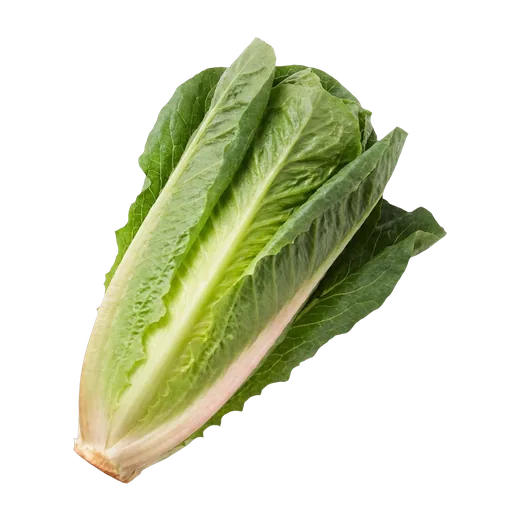
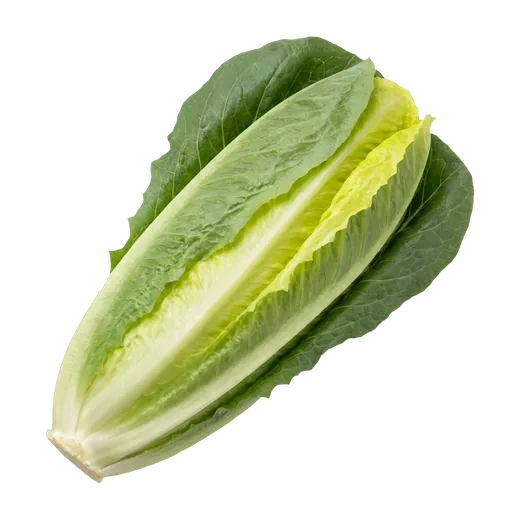
How to pick
Read the ribs first. The broad pale midrib runs the length of every outer leaf and carries almost every fault this lettuce gets — a pink flush, spots, a crack across the rib. You want them even and unmarked. Turn the head over: the cut base should be a clean, pale, freshly-cut face, and tan means it has sat a while. Then the colour — bright to dark green on the outer leaves, and check their tips, where yellowing starts. The innermost leaves are meant to be pale, so judge yellow on the outside only. The top should be closed and furled, not splayed, and the head should stand on its own. Cup it in an open palm — firm with a little give. Never squeeze, never snap a rib. Sealed hearts packs defeat most of that: no base, no outer leaves, no touch. Through the film, three things still read — cut ends pale rather than tan, no brown dried edges on the leaf tips, no water pooled in the bag. The heart is a romaine's sweetest part and its lowest in vitamin C and colour.
Red flags
- A pink flush running along the broad pale ribs of the outer leaves — pink rib, seen in overmature heads and after warm or long storage
- Discoloured brown spots on the midribs, larger and less sharply edged than iceberg's russet spotting — often ethylene damage from fruit stored nearby, though the cause of midrib spotting is not settled
- A crack or clean break across a broad rib, browning at the break — romaine ribs snap easily during packing, and the break browns from the moment it happens
- Yellow creeping in at the tips of the outer leaves at the top of the head — chlorophyll breaking down, and it moves fast once it starts; the innermost leaves are pale yellow-green by nature
- A tan or rust cut base — the head was trimmed a while ago, and romaine browns at a cut faster than other lettuce
- Brown, dried-out edges on the leaves — tipburn, a defect that happened in the field and does not improve on the shelf
How to store
Keep it in the coldest part of the fridge that will not freeze it — lettuce freezes at 31.6 °F (−0.2 °C), so keep the head off the back wall and away from the freezer vent. A normal crisper at about 35 °F (2 °C) is genuinely good enough here: 36 °F (2 °C) is the point below which discoloration in damaged areas is minimized, and a home fridge already sits under it. Put the head in a loose or perforated plastic bag: it wants very humid air, and dry air brings the yellowing on faster, but a fully sealed bag sweats and trapped water speeds decay. Store it whole and uncut. This matters more for romaine than for iceberg — cut or broken ribs go brown faster here than on iceberg, so pulling the leaves apart to store them starts the clock. Wash it after, not before. Expect five to seven days at home, a little less than iceberg: romaine breathes faster, and it reaches you with only two or three wrapper leaves to take the damage instead of the up-to-seven the grade standard allows on a trimmed iceberg. Keep it out of the drawer that holds apples, pears, peaches, cantaloupe or ripening tomatoes — one part per million of the gas they give off is enough, and at fridge temperature it shows up as brown marks on the ribs rather than as yellow leaves.
In the app
Scan
In the aisle, in seconds
Point the camera: pick or pass for that exact item, and the cue to trust next time.

Season where you live · Nutrients · Taste · Myths · Ayurveda


Free to install.
More to pick
Picking, storage, and freshness guidance is drawn from peer-reviewed postharvest research and agricultural extension sources. The sources are named in the app.