Roots · White Radish
How to pick a good White Radish
Bright white sheen and heavy for its size — fresh white radish shows both
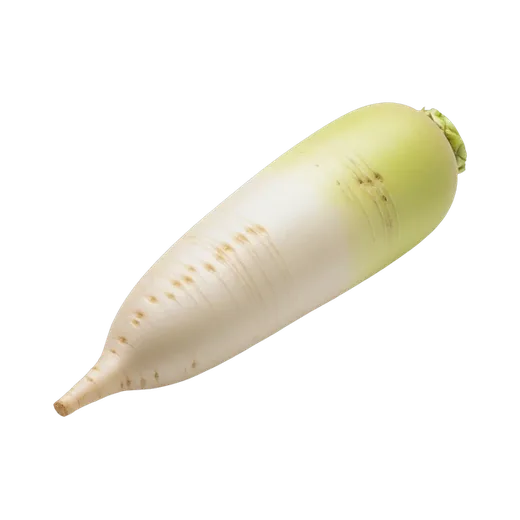
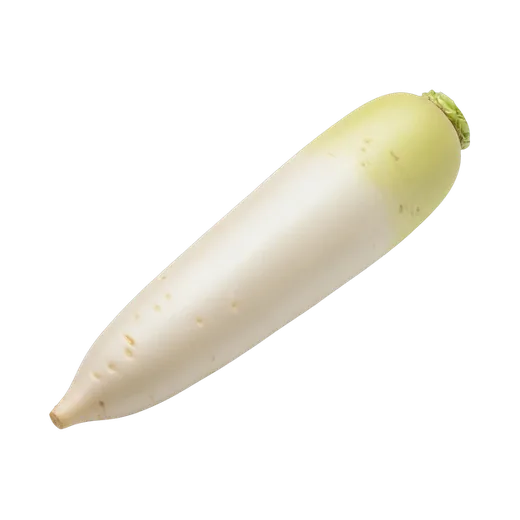
How to pick
Start with the sheen — a fresh white radish has a natural, mild gleam along its white skin, and you can see it from across the bin. Any dullness at the shoulder (the broad top) or the tip is the first sign of moisture loss. Next, heft it: white radish is about 95% water, so a fresh root feels noticeably heavy for its length. If it feels lighter than you'd expect for its size, it has already begun to lose water internally and may be pithy in the center. Aim for medium-sized roots — roughly 2–3 inches (5–7.5 cm) in diameter — which stay crisp and sweet; very large ones, wider than 3 inches (7.5 cm), have a higher risk of a pithy or hollow center. If leaves are still attached, read them first: upright, deep-green leaves with intact margins confirm a recent harvest.
Red flags
- Shoulder or tip skin looks dull or faintly off-white rather than bright white — the earliest sign of moisture loss
- Visible wrinkling beginning to appear along the main body of the root — moisture loss has spread beyond the extremities
- Leaves (if attached) are yellowing, drooping, or have brown-edged tips
- Root feels lighter than expected for its diameter and length
- Any pronounced wrinkling along the main body, soft spots, or visible surface cracks
How to store
Remove leaves before refrigerating — they actively pull moisture from the root, causing it to shrivel within a few days. Wrap the root loosely in a slightly damp paper towel or place it in a bag left partially open, then keep it in the crisper drawer. At typical home refrigerator temperature 35–40 °F (2–4 °C), a topped white radish keeps well for 1–3 weeks. Do not wash before storing — surface moisture accelerates deterioration.
In the app
Scan
In the aisle, in seconds
Point the camera: pick or pass for that exact item, and the cue to trust next time.

Season where you live · Nutrients · Taste · Myths · Ayurveda


Free to install.
More to pick
Picking, storage, and freshness guidance is drawn from peer-reviewed postharvest research and agricultural extension sources. The sources are named in the app.